Written by Ojjas Sharma | Edited by Laura Ionescu
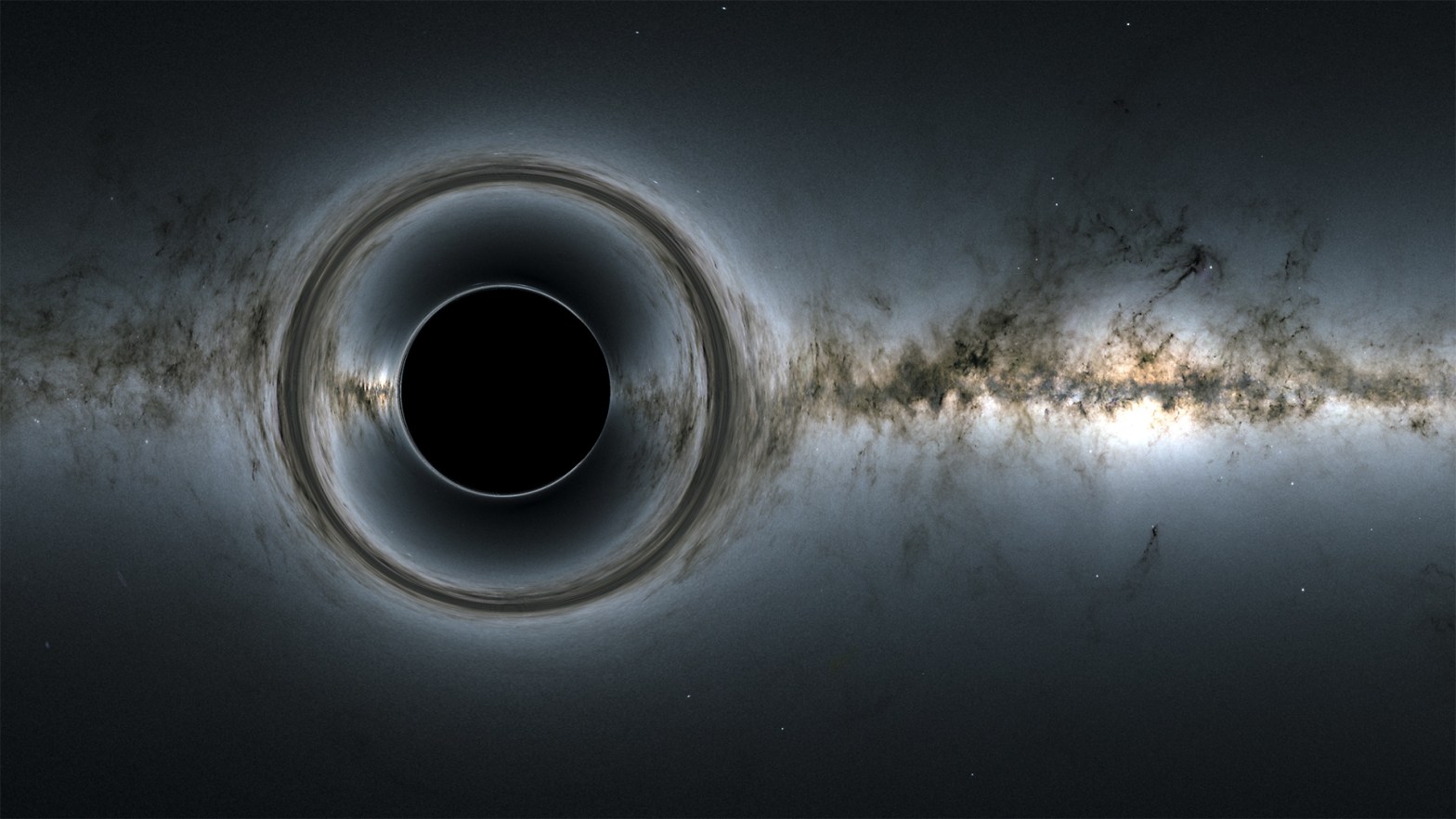
A black hole is defined as a region in spacetime where the spacetime is highly curved, meaning that the gravitational force is so large that even EM radiations are unable to escape its gravitational pull. They are also usually found in the center of galaxies.
Black holes are formed when stars, having 8-13 or more solar masses, exhaust their fuel (hydrogen), which then implode.
When stars use up the hydrogen and fuse it into Helium, the star then uses the helium as a fuel, producing elements with higher and higher Z, such as Oxygen, Neon and Aluminum.
Since the temperature of particles isn’t enough to maintain outward pressure, the core undergoes gravitational collapse. Temperature is defined as average kinetic energy per particle.
Note: This can be avoided by star only in creation of a electron degeneracy pressure, as described by Freeman Dyson in 1967 to explain stability of matter
The elements continue to fuse and when they reach iron or nickel, the iron fuses, but heat is absorbed by the iron, and henceforth, the heat cannot be evolved by the process. This leads to loss of the internal thermal energy. This NiFe core then undergoes an implosion, and the gravitational potential energy is released as Supernova.
These are various types of Supernovae, and they depend upon the mass of remnants of the stars. If the mass of remnant is above TOV limit, then the stars will turn into a black hole. If it isn’t, it will turn into a neutron star.
New TOV limit is ≈ 2.3MΘ (Solar Masses)
But why are Black Holes black? Sir John Wheeler coined the term Black Hole. We know that even Light cannot escape from Black Hole once it has entered Event Horizon. This is because of the Escape Velocity.
Escape Velocity is the minimum Velocity required by an object to escape the gravitational pull or sphere of influence.
Escape Velocity is described as:
V = √(2GM/R)
Black holes possess mass, angular momentum and charge according to no hair conjecture and Kerr-Newman Metric.
You must be wondering: what exactly is a metric? A metric is a well proven Fact. Various Physicists researched upon various conditions and proved them, coming to a general consensus on the topic.
Schwarzschild Metric explains a black hole with M≠0, Q=0, J=0
Kerr-Newman Metric describes Black Holes where M≠0, Q≠0, J≠0
Kerr Metric describes BH ( Black hole) with (Q = 0, J ≠ 0), and Reissner–Nordström metric describes BH with (Q ≠ 0, J = 0) where Q is Electric Charge and J is angular momentum
In fact, Black Holes’ physical Quantities must satisfy following equation:
Q²+(J/M)² ≤ M²
Note: M is Black Hole’s mass, Q is charge and J is angular momentum.
In the simplest case, the BH possess mass but not charge nor angular momentum; such Black Holes are called Schwarzschild Black Holes.
The angular momentum limit for black holes is given by the following Formula:
J ≤ GM/c²
Event Horizon is the boundary around a black hole. When this boundary is crossed by a particle, it is no longer capable of escaping. Event Horizon is more commonly described as a Boundary on Space Time. According to no-hair conjecture, no information can flow out of the Event Horizon except the Three Physical Quantities- Angular Momentum, Mass and Electric Charge; as explained by the Kerr-Newman metric.
The escape velocity of Black Hole at event horizon is the speed of light. This is described as follows.
Contemplating formula for escape velocity, let V = c
Therefore:
c = √(2GM/R)
c² = 2GM/R
R = 2GM/c²
This Radius is called Schwarzschild Radius, the radius of event horizon, and it is given by the formula:
2GM/c² = R
Interestingly, Black Hole with a non zero spin or non zero charge has a smaller radius.
We call these event horizons because any event which occurs within the boundary can’t be observed from out, and hence forth no observations can be made by outsiders. Then how can we predict if something has entered into black hole?
The answer is that anything that is attracted to a black hole releases X-Rays, which when indicate to the presence of black holes. X-Rays are released because the tidal forces acting around the black hole cause a rise in matter’s temperature, releasing various radiations, among which X-Rays are quite prominent.
Black holes are usually classified on basis of their mass.
The smallest type of black holes on basis of their mass are micro-black holes, which have mass equal to 7 x 10²² kg and a radius of up to one millimetre.
The second type of black holes are Stellar size black holes, with mass up to 2 x 10³¹ and radius up to 30 kilometres.
Intermediate black holes have a mass up to 2 x 10³³ kilograms and radius of about 10³ kilometers. Super Massive Black Holes are largest types of black holes, with a mass about 10,000 ΜΘ (solar mass) to 50 billion ΜΘ (theoretically).
They are formed by collision of various stellar black holes with other types of Black Holes and they have a really large radius of about 0.001-400 AU or more.
 hARTS magazine