WRITTEN BY OJJAS SHARMA
Edited by Laura Ionescu
Asteroid fly-bys have become frequent this past decade. Each day we read an article or two where it is mentioned that a couple of asteroids would be passing very close to us. But we all look for one answer to a really important question in those articles: Are there any chances that it would come into impact with planet Earth? We sigh in relief after finding the answer is no, however today we are going to read about a Potentially Hazardous Object that has a high chance of impacting Earth!
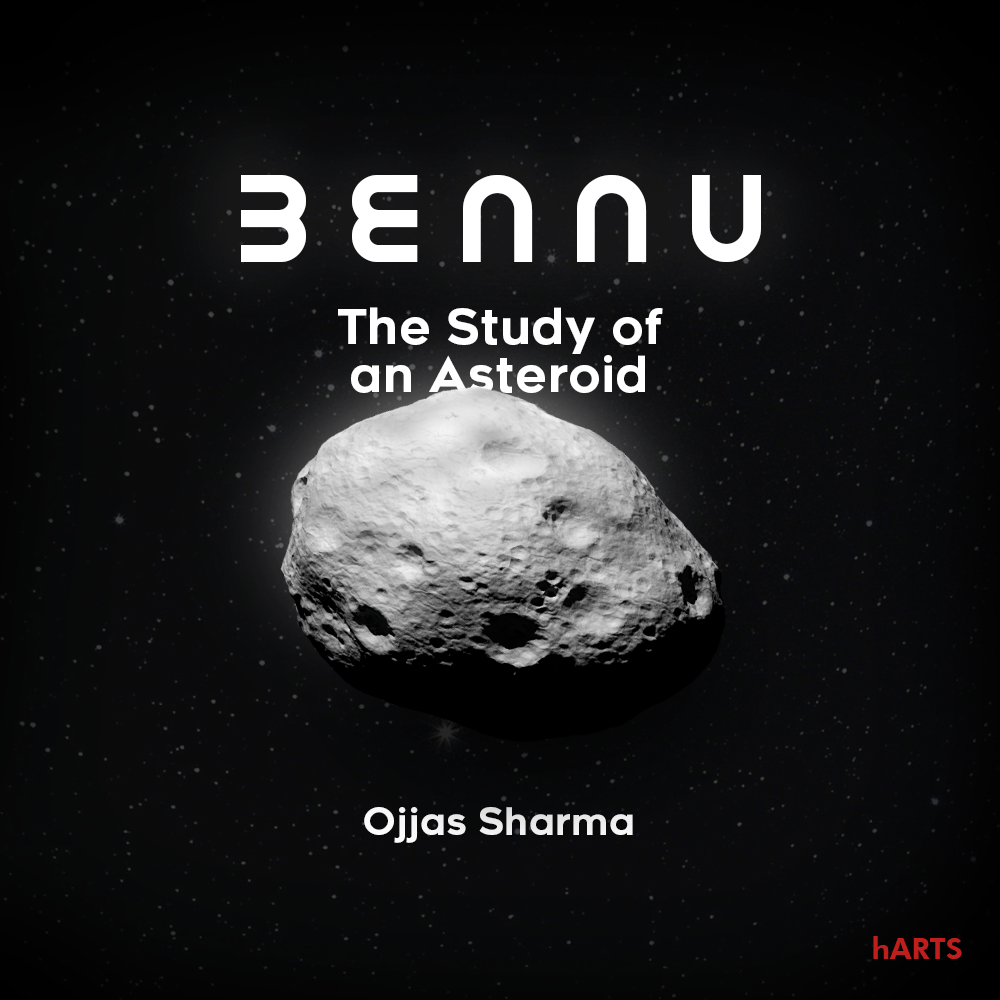
101955 Bennu, commonly known as Bennu, is an asteroid in the Asteroid Belt. It was discovered on 11 September 1999 by the LINEAR (Lincoln near-Earth Asteroid Research), which has been replaced by the Catalina Sky survey. Bennu has a mean diameter of 496 meters, which was interestingly discovered by the Goldstone DSN and Arecibo Observatory: a radio telescope in Puerto Rico, operated by the University of Central Florida and several others, under an agreement with the US National Science Foundation.
Bennu has a surface area of approximately 0.782 km2 and weighs around 7.329 x 10¹⁰ kg. The temperature of Bennu ranges from 236K to 279K, with a mean temperature of 260K.
Earlier observations from Earth showed that it had probably a smooth surface, but soon, the OSIRIS-Rex mission showed us various boulders with a diameter of more than 11 m. The images and data showed us that the surface of Bennu was very rough, contrary to what was believed earlier. Bennu also has a ridge along its equator, which is one of its prominent features.
It is a C-Type Asteroid, which means that it is mostly made up of carbon, in addition to various rocks and minerals. C-Type asteroids basically have a low albedo, which is a measure of the diffuse reflection of solar radiation out of the total solar radiation received by an asteroid. Different reflection can be thought of as a ray that is scattered or reflected at many angles other than the normal reflection. Albedo is measured between a scale of 0 and 1, where 0 corresponds to the black body which absorbs all the incident radiation and 1 corresponds to a body which reflects all incident light, although the latter hasn’t been found to date.
Mathematically, Surface Albedo is the Ratio of Radiosity and Irradiance received by a surface. In simple language, it is the ratio of radiation reflected by a surface to total radiation received by the surface.
Radiosity is the flux of radiant energy reflected, transmitted or emitted by a surface per unit area whereas irradiance is the radiant power which is received by a surface per unit area. Flux is a word used to denote any incoming effect.
Coming back to our topic, what makes Bennu further interesting is that its rotational velocity is accelerating with time! This happens to the YORP effect. In other words, this basically happens because the radiation and striking the asteroid possesses some momentum. We know that radiation is composed of photons. They have some momentum, and this affects Bennu.
P=E/c
[where p is the momentum of a photon, E is the energy of the photon and c indicates the speed of light in vacuum]
Since Bennu has a very high albedo, this means that a huge amount of radiation strikes and reflects. Therefore, the momentum of photons causes the angular momentum, which creates torque, since Bennu has an irregular shape. Here, Newton’s 3rd law of motion comes into play: the reaction force of photons which are re-radiated or emitted from the sides of the asteroid create a torque, since the reaction force doesn’t point towards the axis of the asteroid, therefore contributing to the spin of Asteroid.
Torque is the force applied to an object, causing it to rotate on its axis. Its formula is Force multiplied by the distance from the axis.
Despite being incredibly tiny with a 0 mass, photons follow Particle-Wave duality, meaning that it behaves as a particle, and as a wave. A wave can possess momentum since the time of its creation. Also, this momentum and reaction force never initiates an instant change, meaning that its effect is observed after various years. This affects the shape of Benny’s poles and its spin rate as discussed above.
As a result, the 490 m guy is tilted 178 degrees on its axis, and its direction of rotation is opposite with respect to its revolution. This could even mean that Bennu was hit by another Asteroid which caused this change. But the YORP effect is more compelling.
But why is Bennu so much talked about? Not because of its features, but because it is a Potentially Hazardous Object, listed on Sentry Risk Table. To top it all, it has the second-highest rating on the Palermo Technical Impact Hazard Scale (a scale used by astronomers to rate the potential hazard of the impact of a near-earth object).
It basically measures the hazard as follows:
- A rating of zero is a base mark, which is also called background hazard and can be thought to have equal likely and unlikely consequences of hitting Earth. This background hazard is defined as the risk of random impacts henceforth.
- A rating of +2 would indicate the hazard is 100 times greater than a random event happening at that time.
- A rating of -2 means that there are no likely consequences of the object hitting Earth.
Objects rated between -2 and 0 are carefully observed since they pose some risk.
Only 2 objects till now have been rated above -2. The first one is 1950DA, an asteroid, which had the highest probability of impacting Earth in 2002. It has a rating of -1.42. The next object in question is Bennu, with a rating of -1.69.
This makes Bennu incredibly hazardous. It is thought that Bennu would probably impact Earth in the last quarter of the 22nd century.
In regard to Bennu, OSIRIS-Rex mission has been launched by NASA, operated by Goddard Space Flight Centre and Lockheed Martin to study Bennu more closely. Launched by another Atlas V rocket, it would give you some idea about the types of equipment on-board and its work. The full name is Origins, Spectral Interpretation, Resource Identification, Security and Regolith Explorer. This spacecraft is Bennu-centric and entered Bennu’s orbit on 31 December 2018. It is planned to return to Earth by 3 March 2021 with a sample of a rock from Bennu, weighing around 60 grams.
As the Space exploration would continue, projects like LINEAR and Catalina Sky Survey would be initiated, more and more NEO would be detected, and it is possible that they would have a rating of +2 too on Palermo Scale!
 hARTS magazine