PART 1 BY GEORGIA MIRICA
Prague Spring refers to a short-lived period of liberalization in the history of communist Czechoslovakia, under the leadership of a newly-elected First Secretary of the Communist Party, Alexander Dubcek. The reform program proposed in April 1968 included granting Slovakia autonomy, providing rehabilitation to citizens that had been victims of severe purges conducted under the orders of Joseph Stalin, constitutionally stipulating the protection of civil rights and freedoms of citizens (including freedom of press), and a democratic restructuring of the government, among others. Dubcek called his plan “socialism with a human face.” These moves towards democracy gained public support, encouraging further liberalization (The Editors of Encyclopaedia Britannica). While Dubcek claimed that the reforms of the country could be controlled, and that the socialist essence of the regime would remain, “Moscow viewed events in Czechoslovakia as something like a virus, fearing they would spread and infect other Warsaw Pact nations” (Santora). Invoking the Warsaw Pact, an agreement for collective defense among the socialist states of Eastern and Central Europe that provided the grounds for the violation of sovereignty, for the future of socialism, the USSR led a large-scale invasion into Czechoslovakia in order to topple the unfavorable leadership, or liberate the country (The Editors of Encyclopaedia Britannica). This took place against a nocturnal backdrop, beginning and ending in the late hours of the 20th of August and the early hours of the 21st of August, 1968. According to the New York Times, “Some 250,000 troops from 20 Warsaw Pact divisions swept across Czechoslovakia, with 10 Soviet divisions filling the positions they vacated. They were backed by thousands of nuclear weapons pointed at Western and Central Europe”(Santora). Following the Soviet re-claiming of power, old party officials reclaimed power in the administrative structure of the Czechoslovak Communist party and Dubcek was deposed from office in April 1969 (The Editors of Encyclopaedia Britannica). All of his reforms were undone.
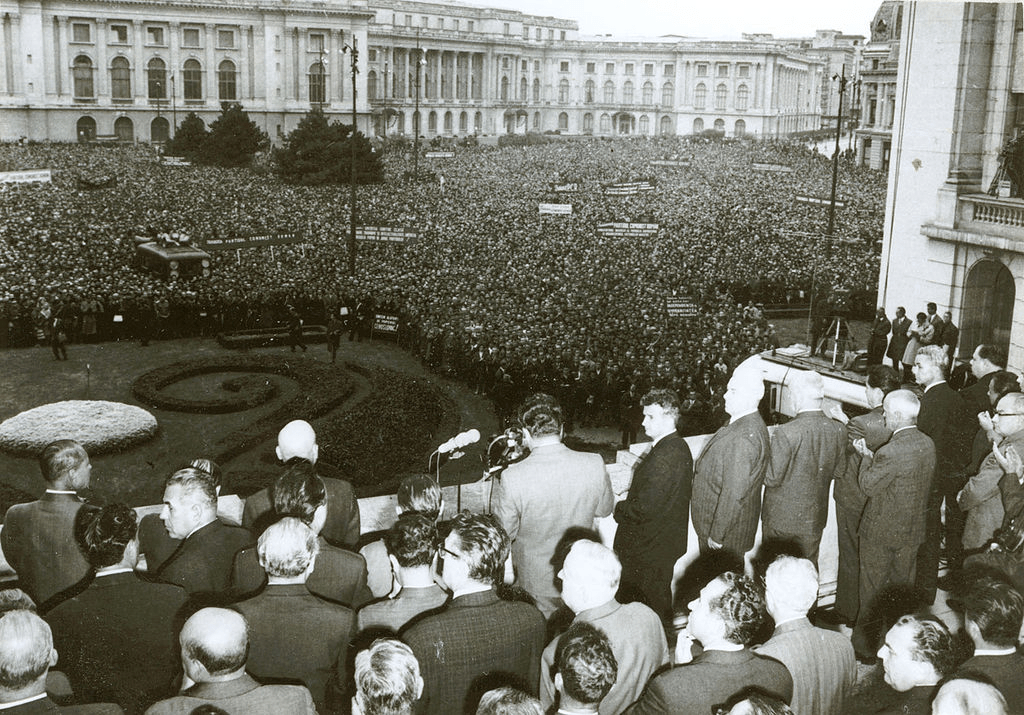
This sequence of events polarized an already divided international community, but one of the most critical and vocal responses came from the Socialist Republic of Romania, a fellow member of the Warsaw Pact that had abstained from participating in the invasion and whose figure of leadership, Nicolae Ceaușescu, harshly condemned the violent and oppressive intervention of the USSR into a sovereign country’s internal affairs in an infamous speech made just a few hours after the eruption of the conflict: “We know, comrades, that the invasion of Czechoslovakia by the five socialist countries constitutes a great mistake and a grave threat to peace in Europe and to the fate of socialism in the world. There is no justification for it and no reason can be accepted to entertain for even a second the idea of the military intervention in the affairs of a socialist state. We will never betray our motherland, the interest of our people” (“TVR 60: Nicolae”). Amid an increasingly tense transnational climate, this response was received by governments around the world and by the general public as “the most forceful affirmation of independence from Soviet dictates” (Deletant). As such, it is simple to label this event as the genesis of the deterioration of Romanian-Soviet relations. While the invasion of Czechoslovakia does hold importance as a pivotal turning-point in relations between Romania and the USSR, tensions had in fact been building up for many years prior, and, in many ways, the denouncement of the actions pursued by the members of the Warsaw Pact could be regarded as a symptom of the desire to break away from Soviet control, as the process of rupture had started many years before, under the leadership of Gheorghe Gheorghiu-Dej.
STAY TUNED FOR PART 2!
 hARTS magazine