by Violeta Mihai
Spanish is the second most spoken language in the world (after Mandarin Chinese) with 500 million native speakers worldwide, and also the second when it comes to second languages. It is one of the most romantic ones, and knowing just a bit of it opens up to you countless opportunities for travel, literature and music.
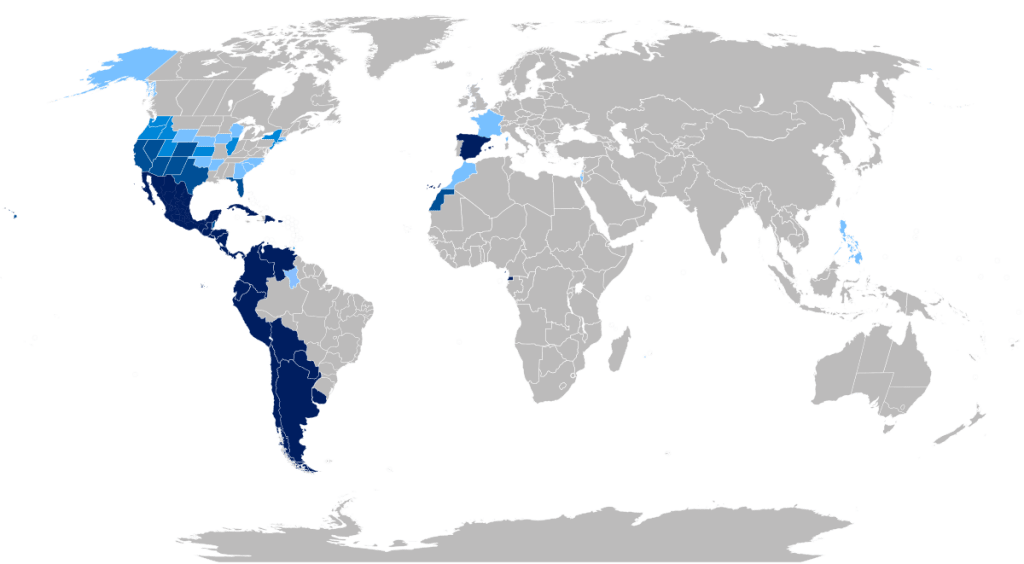
South America vs Europe
As expected, the geographical position makes its presence felt when it comes to how Spanish is spoken on these two continents. The most obvious difference between the Castellano spoken by Spaniards and the Español spoken by Latin-Americans is the pronunciation of z, ci and ce which in Spain is like a “th” and in South America is simply “s”. Then, some countries pronounce y and ll like the English y, but others say it like a soft j. For example, Hola me llamo Francisca in Columbia would be pronounced like Hola me jama Fransisca and in Spain would be Hola me yama Franthisca. Regarding the grammar, if we want to speak to a group of friends for instance, we would use the second-plural form (you all), which is Madrid would be vosotros (informal) and ustedes (formal). But in Montevideo the former does not exist at all, so you don’t need to learn a new way to conjugate a verb. The sentence Vosotros trabajáis does not make any sense anywhere but in Spain and it is replaced with Ustedes trabajan.
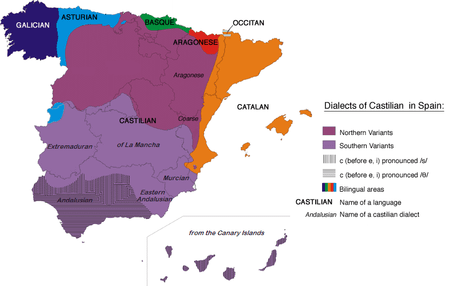
Spain’s dialects
You might think that in a country relatively small as Spain, you will encounter just some small variations of the language. Nothing further from the truth, because every region has its own dialect. There are 4 major ones: Castilian, Catalan, Galician and Basque. Castellan is the official language and it is spoken in the most part of Spain (including Madrid), Catalan is spoken on the eastern coast in (Barcelona, Valencia and Andorra) where the local universities teach in Catalan. Galician shares some common features with Portuguese, but Basque on the other hand is not even a romance language and it’s considered to be the oldest european language. Below we have a comparison.
English: The weather in Spain is great all year round.
Castellan: El clima en españa es excelente todo el año.
Catalan: El clima a Espanya és excellent durant tot l’any.
Galician: O tempo en España é grande durante todo o ano.
Basque: Espainian eguraldia bikaina da urte osoan.
Spanish as second language
Spanish is often regarded as the most useful and easy to learn romance language. Its phonetics are simple comparing to French or Portuguese and it has an official status in 21 countries in North America, Europe and Africa. So, if you already study another romance language, it might be interesting to take on this new challenge.
 hARTS magazine