by Georgia Mirică
Tuscany is a region located in the centre of the Italian peninsula, bordering the Mediterranean Sea on its west coast. It is highly acclaimed for the picturesque beauty of its rural landscapes as well as for the grandeur of its collection of Renaissance artwork. Indeed, this is a realm unlike any other. Every day, the sun rises high above the suave Tuscan hills, caressing them with its golden light, greeting plant after plant and making it so that the air carries the divine perfume of grapes and wheat all around Chianti and Val d’Orcia.
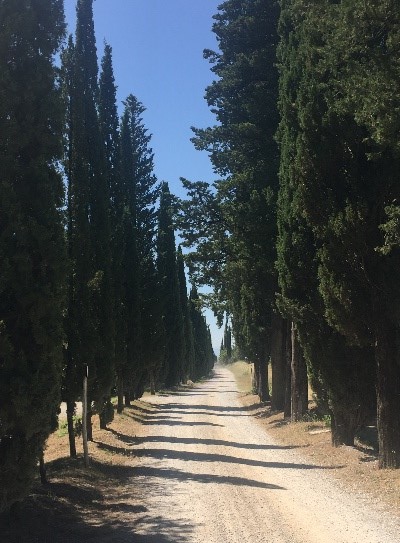
Tall cypress trees line curved roads and mark clusters of stone houses, so tall and slender that they seem to either hold up the sky or pierce it. It is this landscape that birthed generations upon generations of painters such as Leonardo da Vinci and Fra Bartolomeo and inspired many more. Its natural beauty is almost unearthly, as if painted each and every dawn by the cherubim that glide above it, momentarily unfrozen from their statuesque positions in the carved marble statues and coloured frescoes that adorn church walls, ceilings, and facades. After having spent ten days exploring parts of this vast and wonderous domain, I will now, to the best of my ability, aim to encapsulate the essence of Tuscany in a nutshell.
Tuscany draws its name from the Etruscans, its early inhabitants (many Etruscan ruins can be found around the region). It was ruled by the Roman empire and, when the empire fell, the major cities of Florence, Pisa, Lucca, and Siena were stuck in a period of stagnation from many points of view. The cities were city-states that were ruled over by elected consulates. Modern historians liken this system of governance to an oligarchy, in which a group of influential individuals kept their status while not all citizens benefited from political freedom. In the late 14th early 15th centuries, the cities of Arezzo, Pisa and Livorno were annexed and bought, respectively, allowing Florence to assert its dominance of a sizeable portion of Tuscany. It is during the 15th century that a family of bankers rose to prominence- the Medici family. They assumed a central role on the political and military scene of Florence (falling both in and out of popular favour), so much so that several members of the family gained the papacy.

Pope Clement VII, of the House of Medici, for instance, created the Duchy of Florence which he subsequently awarded to Alessandro de Medici in the first third of the 16th century. His successor, Cosimo de Medici, after playing a pivotal role in the Italian Wars and conquering the city of Siena in 1555, was elevated as Grand Duke of Tuscany. In 1737, the Medici line died out and the Grand Duchy was taken over by the House of Habsburg-Lorraine, its first holders being Francis I and Maria-Theresa, Holy Roman Emperors. During the Napoleonic Wars, the heir to the Duchy was forced out of the state, which became the Kingdom of Etruria. The state of Tuscany was restored after the Wars. In 1859, Tuscany became part of the Unified Powers of Central Italy and in 1870, Italy was unified. From 1865-1871, Florence served as the capital of Italy.
The rulers of Tuscany were deeply attached to culture and endorsed the cultural development of the region, especially of Florence, which resulted in an essential cultural and scientific legacy in the form of the Renaissance as well as in the adoption, during the Renaissance, of the Tuscan dialect (each region had and continues to have a distinct language or dialect, seeing as, for a large part of history, the regions were not unified and each developed at its own pace and in its own way) throughout the Italian regions as the language of culture, playing a role not unlike that of the French language in Romania during the Interbellum period.

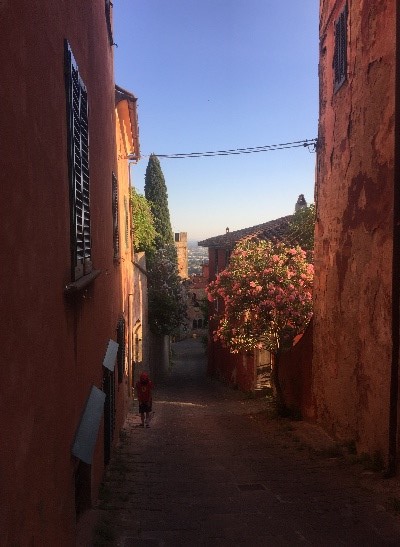
Geographically, the larger region of Tuscany is divided into nine provinces, the most remarkable of which (from an aesthetic point of view) is the province of Siena. The landscape is dominated by hills that occupy two thirds of the total land area of the region. Siena shares custody of two prominent agricultural regions that are UNESCO world Heritage Sites, Chianti and Val d’Orcia. The former is known for its vineyards that produce some of the finest wines in the world, and the latteris renowned for the beauty of its geographical and topographical features, namely, the smooth hills covered in a golden blanket of wheat crops. Each hill seems to have its own castle perched on its uppermost point. Along the snaking road on which the occasional automobile travels, villages grow- clusters of medieval stone houses, really- and, hanging on to the sides of hills, fortified towns can be seen in the distance.

What makes towns such as these notable, in my opinion, is the harmony in which they coexist with the natural landscape around them- how, between tall medieval buildings, slivers of valleys can be glimpsed. Moving toward the north of Tuscany, around Florence, the land begins to level itself and becomes, more or less, even. Hills and mountains form a ring around this flat portion of land. As the land begins to flatten, the landscape is, admittedly, more traditionally urban and lost is the picturesque atmosphere of Siena. However, within these cities, such as Lucca, (the capital of the province of Lucca) one can be fascinated by the historical centres that retain their own distinct kind of charm and paint a picture of life in the birthplace of the Renaissance.

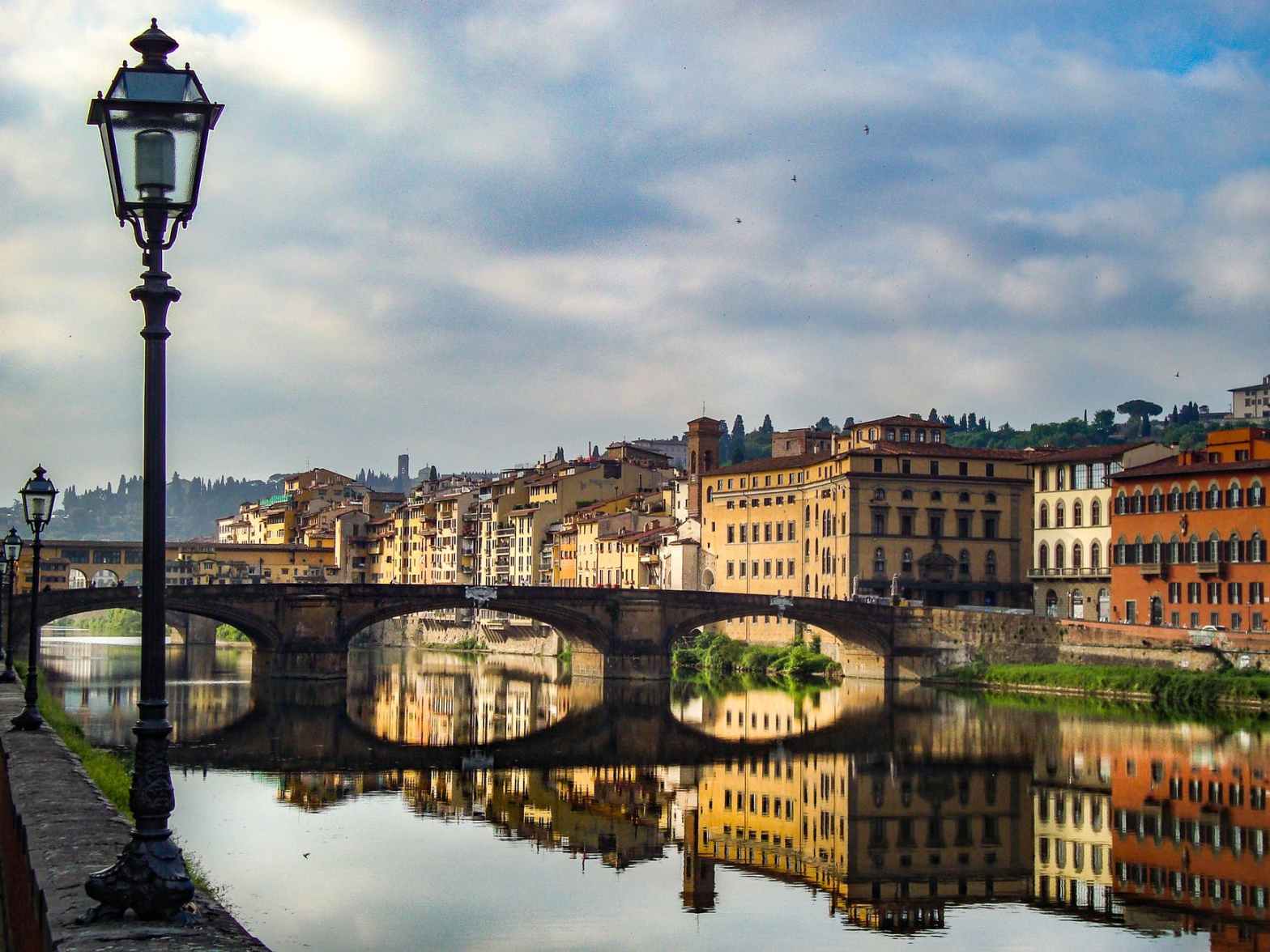
Yet, the urban sight that truly dazzles is Florence. Florence, with its narrow cobbled streets and tall old buildings, with its architectural gems and breath-taking palazzos. Florence is beautiful, but as a testament to the power of human thought and creation rather than of the natural processes that formed the hills and vegetation of Siena. Here, Romanesque, Renaissance, Art Nouveau and Medieval styles come together to compose one of the most structurally interesting skylines in Europe. A significant constituent of this skyline is the Duomo di Firenze (Cattedrale di Santa Maria del Fiore), which can be found in the centre of the city. Despite the size of human settlements, villages, towns, and cities alike, this is a recurrent element throughout.

Whether one agrees or not with its principles and core beliefs, it is undeniable that Christianity has played a massive role in shaping human life, society, and history. This is evident when looking at an inhabited community. Buildings and palazzos elegantly crowd around a grandiose and imposing holy edifice, which occupies a central geographical position in the community, and undoubtedly occupied a central position in its life and society for centuries.
In many ways, a settlement grows around a church because the society itself grows around the principles and functionality of the church. Because of the quotidian dependency and authority of the church in the Middle Ages and the period of the Renaissance, cathedrals and churches, especially in large towns and cities, are true architectural marvels that combine several styles and are usually built in the course of centuries. In rural areas, churches tend to be smaller, built of stone, not unlike the other buildings, but present and central nonetheless.

In the Middle Ages, the ruling Medici family, seeing as they were great patrons of the arts, invested in the creation of a strong cultural society in the city and larger region, creating an environment productive to the flourishment of the arts and sciences. As a result, Florence is now synonymous with the Renaissance (fr. rebirth), a
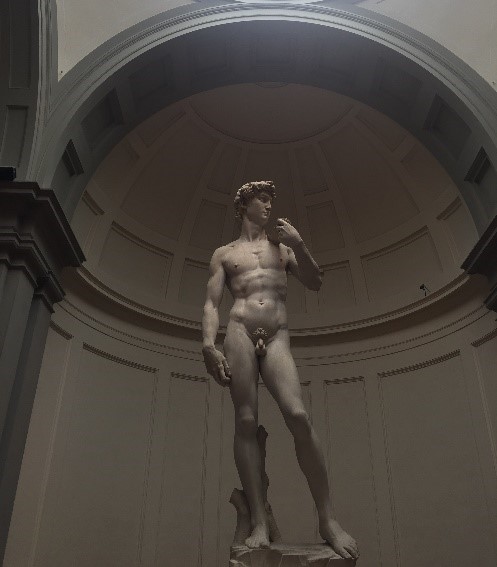
time of advancement that symbolized the transition from the bleak and stagnant years of the Middle Ages to modernity. While museums in the small towns of Tuscany are mostly dedicated to medieval religious paintings, larger galleries in cities proudly display artwork by the likes of Leonardo da Vinci, Michelangelo Buonarroti, and Sandro Botticelli. This is an age in which Machiavelli’s political philosophy is published, an age in which Petrarch composes the sonnets that would go on to inspire Romanticism, and Galileo Galilei presents and argues in favour of his theories of heliocentrism- all in the same
region of Italy.

Tuscany, then, can justly be considered the cradle of modernity, of advancement, of progress, the place that has inspired such great changes but that appears unchanged. While in rural Tuscany, sailing on the sea of vineyards, looking out from within the town walls, it is easy to forget everything but the sight before one’s eyes, or that simply may be a trick played by Bacchus. The heart of the region is beating at the same pace it was hundreds of years ago, and it spreads its red, intoxicating blood all throughout to be enjoyed.
Apart from the world-famous wine, Tuscan cuisine includes several notable dishes. Bread is an important part of every meal and is even featured in a salad called Panzanella, which consists of bread either softened or toasted mixed with sliced tomatoes, red onion, and cucumbers on occasion, and is also served as soup. In terms of pasta, the signature pasta of the region is called Pici and it resembles thick spaghetti. It can be served with a variety of sauces: al ragu (meat sauce), ai funghi porcini (mushrooms), al tartufo (truffles), al pomodoro (tomato sauce). Specifically in the city of Florence, a popular meat course is Bistecca alla Fiorentina, a steak served rare on the T-bone, which is very tender and flavourful.
I hope that I have managed to paint a profound picture of the Tuscan realm, to transfer some of its wonder into words. There is truly something for everyone in Tuscany, and a world that awaits discovery. Ah, if only I could colour the outline I have provided! Alas, maybe now, dear reader, you will consider the destination of Tuscany for your next post-pandemic adventure.
Post-Script:
The concepts of agritourism and rural tourism are marketed to tourists wishing to visit Tuscany and this form of travel is truly memorable and, from some points of view, more authentic. Because some of the most notable sights of Tuscany consist of small medieval villages, renting an automobile is highly recommended if one is planning to visit the rural areas. In Florence, parking near the city centre can get quite expensive.

TO-VISIT
IN CHIANTI
Castello di Brolio; Panzano; Castellina
IN VAL D’ORCIA
Buonconvento; Pienza; San Quirico d’Orcia
SIENA
Cattedrale Metropolitana di Santa Maria Assunta; Museo dell ‘Opera; Piazza del Campo
SAN GIMIGNANO
VOLTERRA
LUCCA
Cattedrale di San Martino; Chiesa di San Michele in Foro; Museo di Giacomo Puccini
FLORENCE
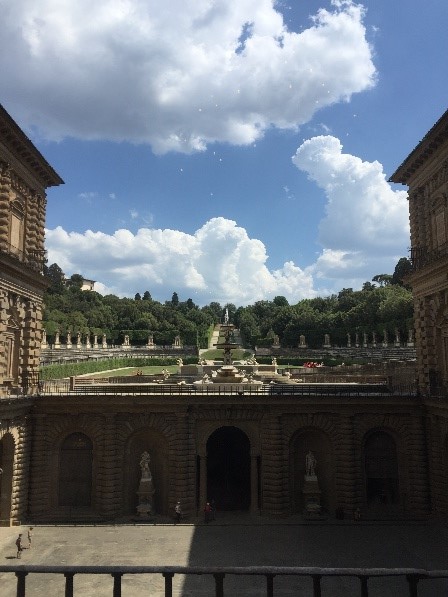
Cattedrale di Santa Maria del Fiore; Ponte Vecchio; Palazzo Vecchio; Palazzo Pitti; Galleria Uffizi; Galleria del Accademia
Works Cited
Cesati, Franco. The Medici: Story of a European Dynasty. Firenze, La mandragora, 1999.
Strathern, Paul. The Medici: Godfathers of the Renaissance. London, Pimlico, 2005.
 hARTS magazine